Public spending
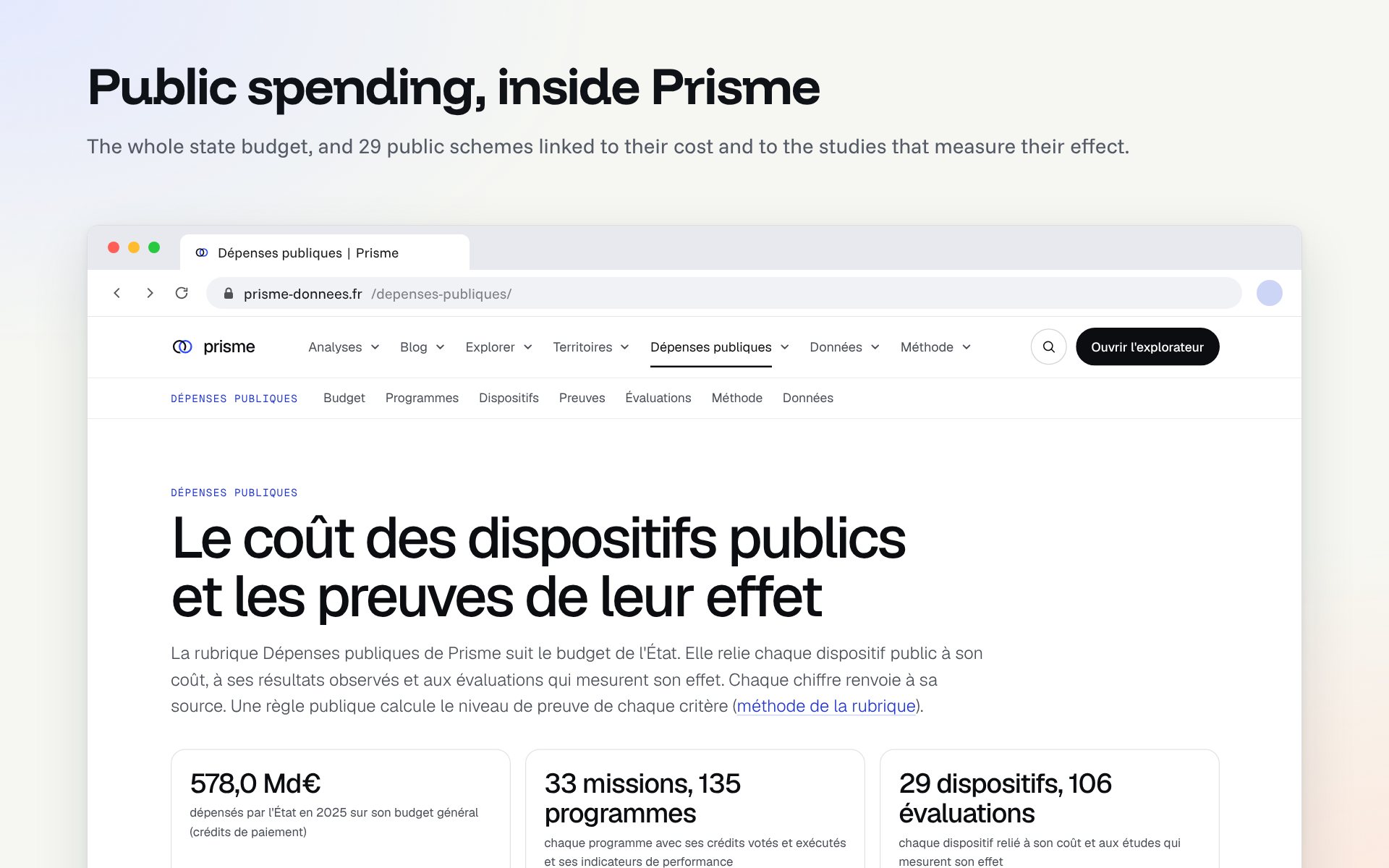
A section of Prisme that links each public scheme to what it costs, to the results observed among the people it reaches, and to the evaluations that measure its effect, with a level of evidence computed by a public rule.
- Budget
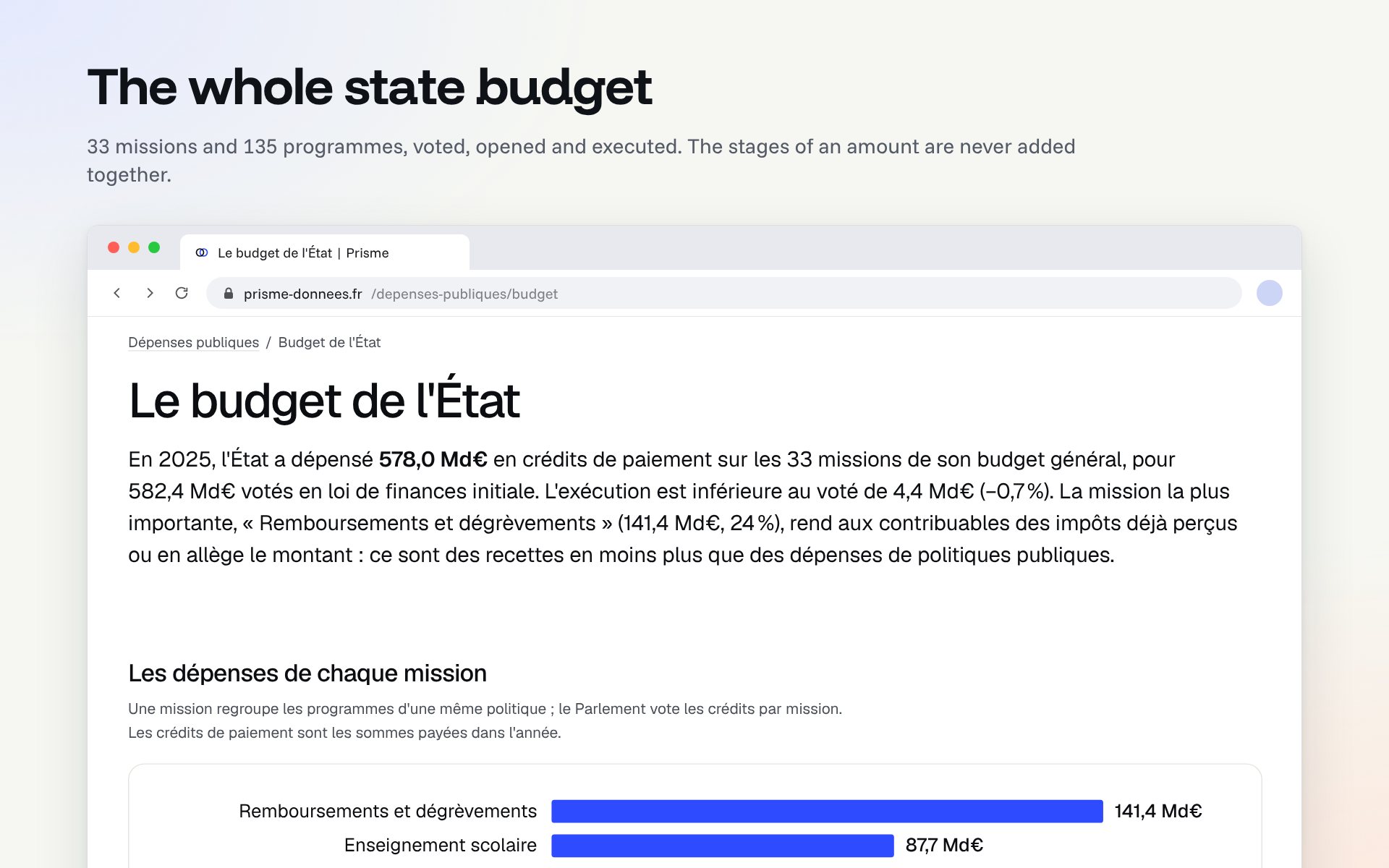
- €578.0bn spent by the State in 2025 on its general budget, across 33 missions and 135 programmes, each with its voted and executed credits and its performance indicators
- Schemes
- 29 public schemes, from the prime d’activité to the research tax credit, each with its cost, its reach and its evidence map
- Evaluations
- 106 studies cited, each with its method, its rank and whether its authors are independent
- Documents
- 206 documents kept with their fingerprint, so anyone can tell which version was read
- Code
- 10,700 lines of Python, 25 dbt models, 247 Python tests and 16 decision records, in a repository of its own
Counted on the live site and in the registry on 25 October 2026.
The question
What does a public scheme cost, and what does it achieve?
The answers exist, but they are scattered. The voted credits are in the finance law, the executed ones in the annual performance reports, the effect in academic papers and in reports by the Cour des comptes. They are rarely put side by side, and the strength of each piece of evidence is seldom said. A cost per beneficiary doesn’t measure efficiency, and the share of beneficiaries in work six months later doesn’t say what they would have done without the scheme.
The section started on 22 October as a project of its own, with its own name and site. The next day it became part of Prisme: two sites meant twice the legal pages, the data watch, the SEO and the branding, for one person.
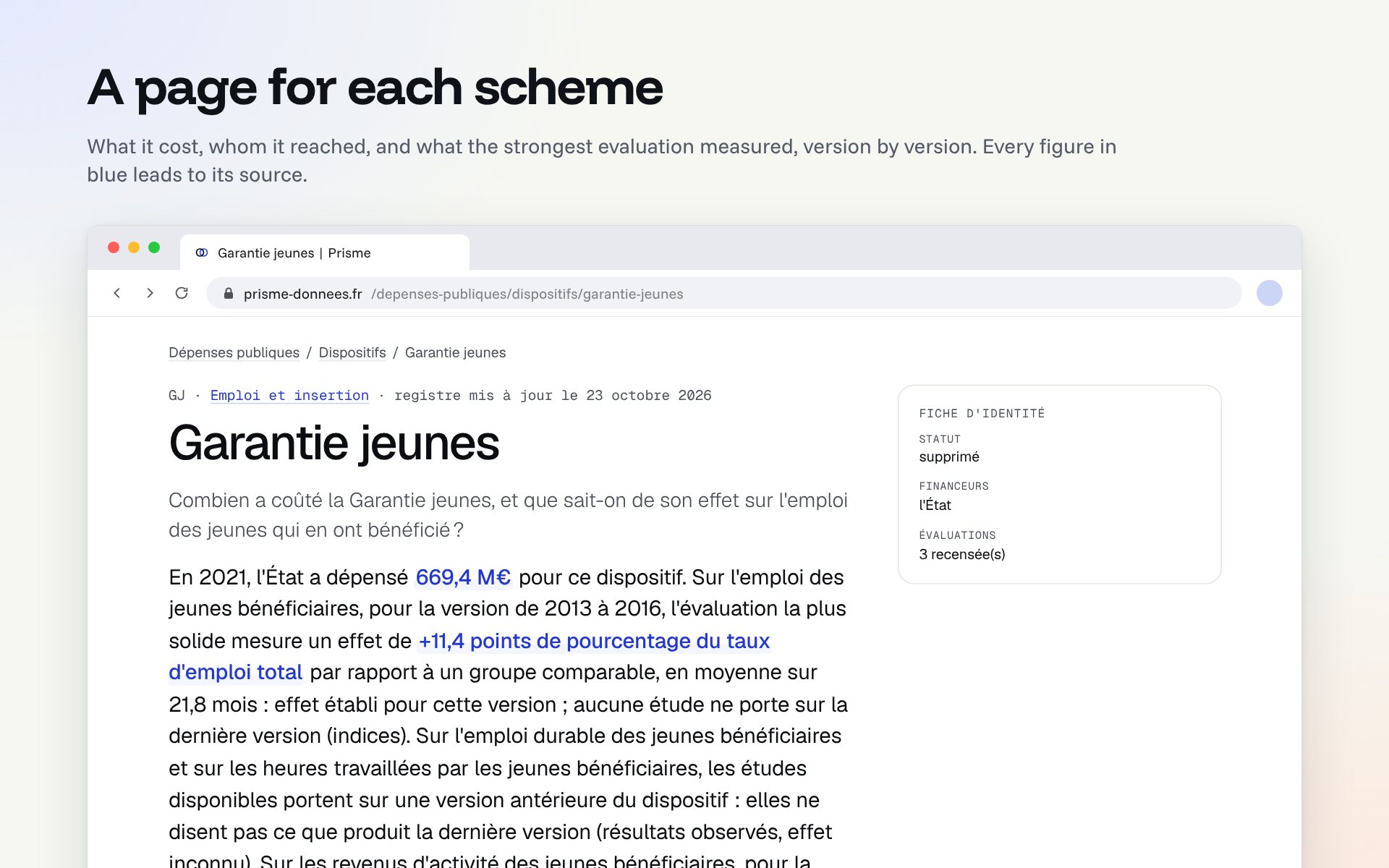
One question per scheme
Each page asks one question in its title: what did it cost, and what do we know about its effect? Its first paragraph answers with the figures that are known, and says which version of the scheme each one is about.
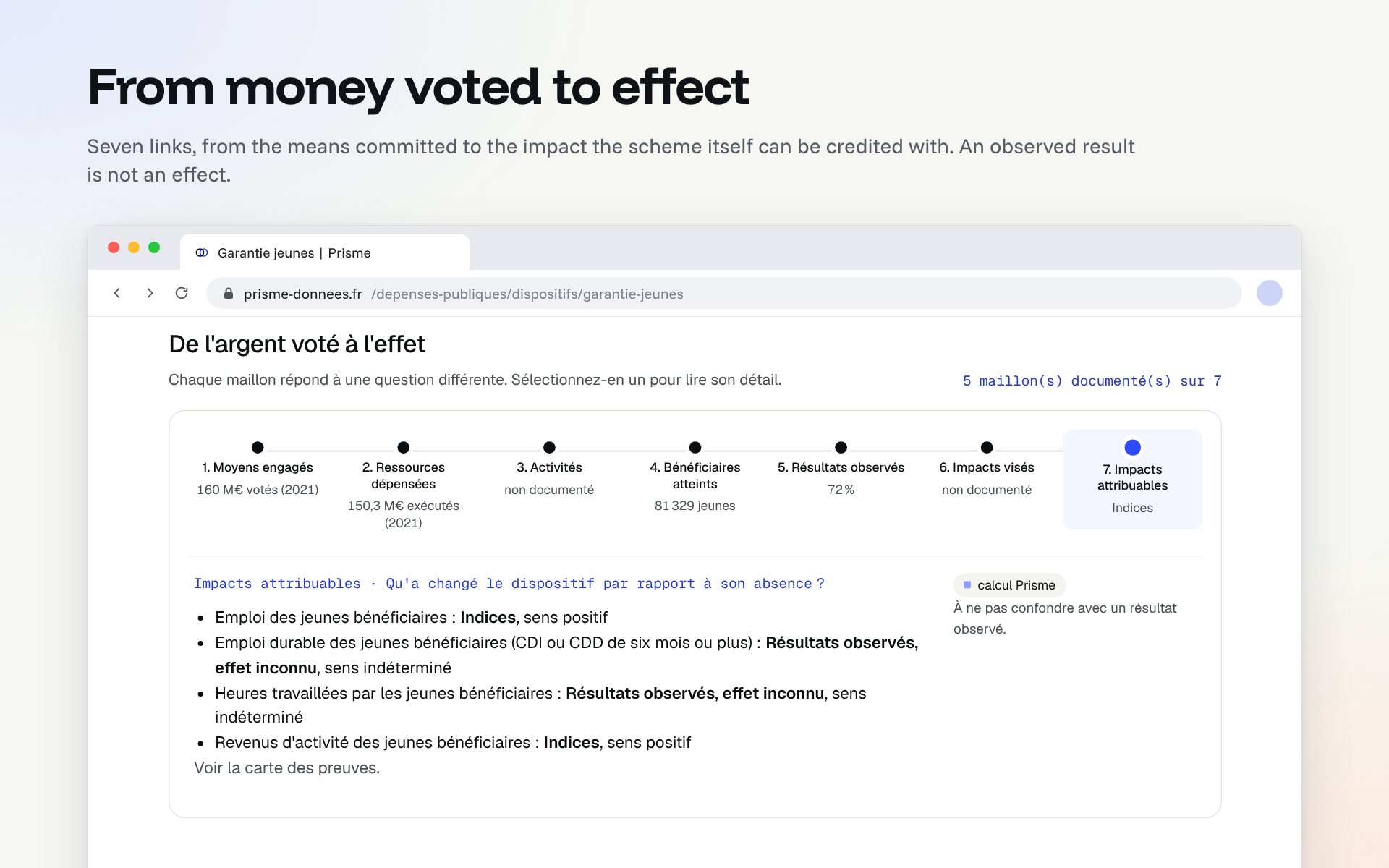
Four stages, never added
An amount is planned in the finance bill, voted by Parliament, opened during the year or executed. Two stages never add up, any more than commitment and payment appropriations do.
Four kinds of information
A published fact, a calculation by Prisme with its formula, an estimate by a third party, or an interpretation, always attributed. Each value on a page carries its kind.
A result is not an effect
Only an evaluation that builds a credible comparison group measures an effect; a model can estimate one, under its assumptions. A performance indicator doesn’t measure an effect either, and hitting a target says nothing about efficiency.
Nothing ranked
No scheme gets a score or a rank: effects measured on different criteria and populations don’t compare. A cost per effect is never recomputed; the page quotes the one an evaluation publishes.
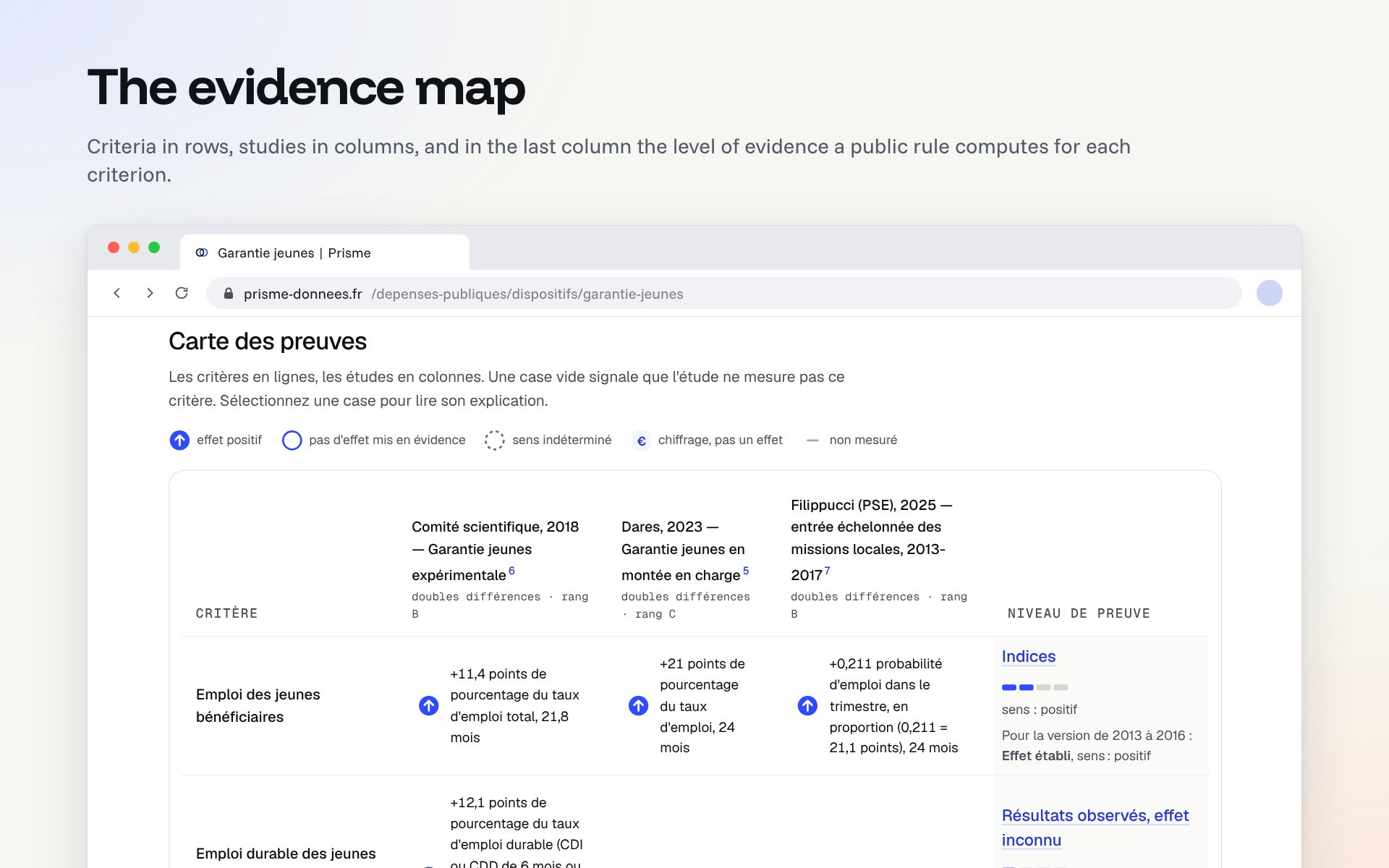
A level of evidence, computed
Two things are shown apart and never merged into a score: the direction of the effect, and how solid the evidence is. A rule in the code computes the level for each criterion, never for a scheme as a whole.
| Level | Label | Rule |
|---|---|---|
| 0 | No evaluation of the effect found | No evaluation measures this criterion. |
| 1 | Observed results, effect unknown | Only descriptive studies (rank D): beneficiaries followed over time, before and after with no comparison. |
| 2 | Hints | One study with a rough comparison (rank C), a simulation, or a strong study (rank A or B) that is neither independent nor published with its data and code. |
| 3 | Probable effect | At least one strong study (rank A or B) that is independent, or whose data and code are published. |
| 4 | Established effect | At least two valid strong studies from different institutions, agreeing on the direction, one of them on the current version of the scheme. |
What lowers a level
- Strong studies that contradict each other on the direction of the effect.
- A study of another version of the scheme, another population or another period.
- An effect measured over less than 24 months when the official goal is long term.
- An imprecise estimate, whose interval is compatible with no effect at all.
Schemes change their amounts and their public. A solid study of a past version doesn’t say what the current one achieves, so the criterion drops a notch, and the page shows beside it the level for the versions the studies cover. The rule also settles eight points the method left open; they stay proposals until researchers have reviewed them.
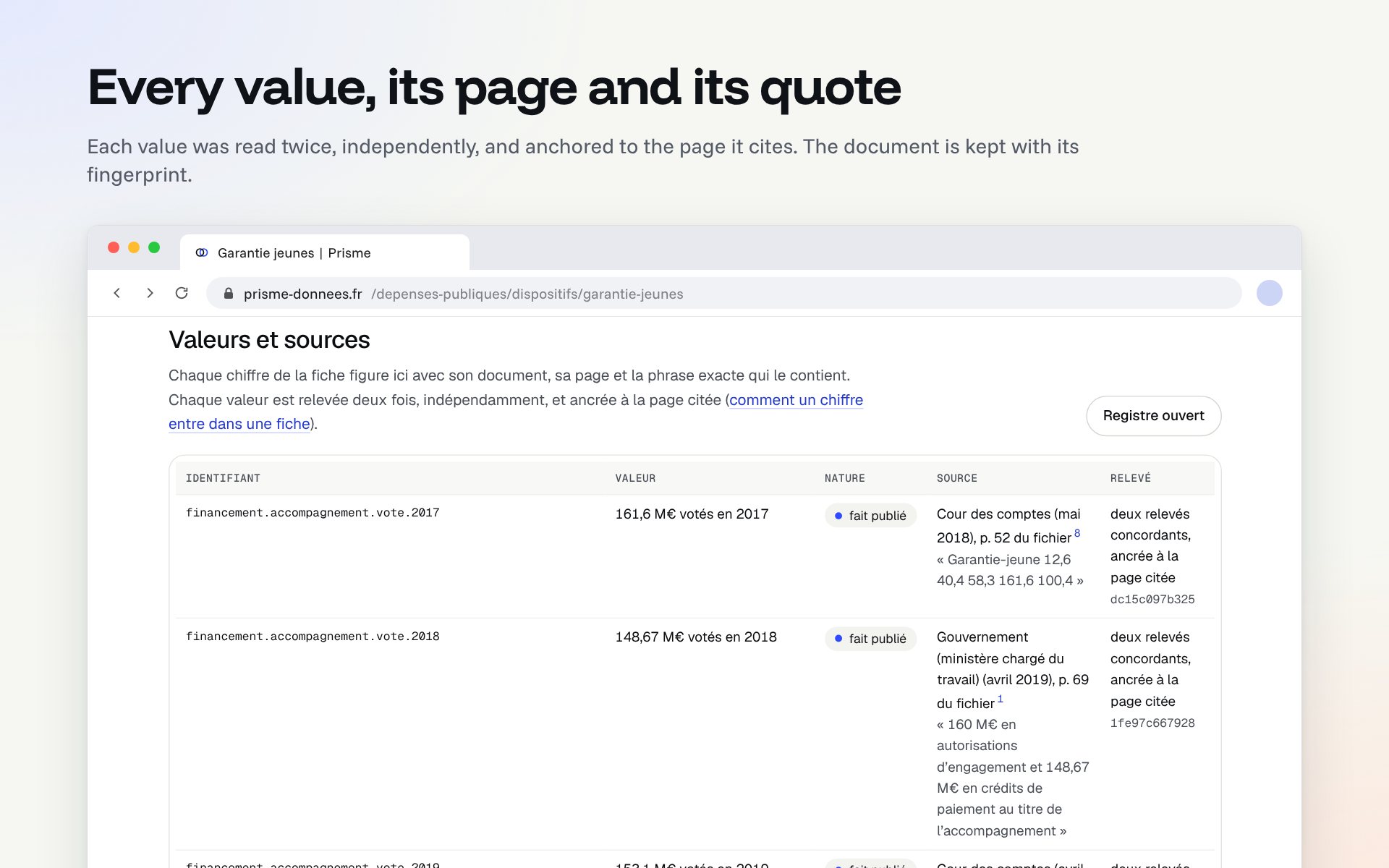
How a value gets into a page
Nothing is written at build time. A page assembles values read in documents, published data and declared calculations. Budget amounts and performance indicators come from published datasets, and their totals per programme are checked against a second one.
- ArchiveThe cited document is downloaded and kept with its fingerprint. It is quoted, never republished, and treated as untrusted data: nothing in a PDF is ever run.
- Read twiceEach value is read twice, independently, from the same questionnaire. Neither reading sees the other, and each works from its own text extraction of the document.
- AnchorThe quoted sentence has to be on the cited page of the document, and the number in the sentence. The check is automatic.
- CompareWhen the two readings differ, the value isn’t published until a person has decided, document in hand. The page says a decision is pending, so a missing value doesn’t pass for one that doesn’t exist.
- VerifyThen a person checks each value at the cited page. That hasn’t been done yet, and the section’s method page says so, once.
One site, two repositories
For readers, it’s one site. Behind it, two builds that can’t break each other.
The section keeps its own repository, warehouse, evidence registry, CI and deployment. It builds its whole site under /depenses-publiques/, and Prisme’s Vercel configuration rewrites that path to it. The header, mega menu included, and the footer are the ones Prisme publishes at each build: the section fetches them at the start of its own, falls back on a versioned copy if it has to and says so, and a copy older than 30 days stops a strict build. Once built, every page is checked: links, canonical address, weight, Prisme’s header and footer, and the error report address of that page.
What’s left
The chain is in place. The human part comes next.
Settle every gap between the two readings, check each value at its page, have the texts of each page reread, and submit the evidence rule to researchers. Each page will also go to the administration and the operator concerned, for a factual check, with no right of veto; their answers will be summed up on the page.