Clivio
- Role
- Founder: product, design and code
- When
- November 2025 to today
- Status
- Live at clivio.fr, free plan open
- Stack
- Next.js, Firebase, Gemini
The document vault I wished I had. I designed and built it on my own, with AI coding agents doing a lot of the typing. You send it your paperwork, it reads it, files it, picks out the amounts and dates, and answers your questions about it.
Eleven months, 524 commits and about 294,000 lines of TypeScript later, here’s what it does, the website that sells it, how it’s built, how it came together and what it looks like.
The problem
Cloud storage keeps your files, but it never reads them.
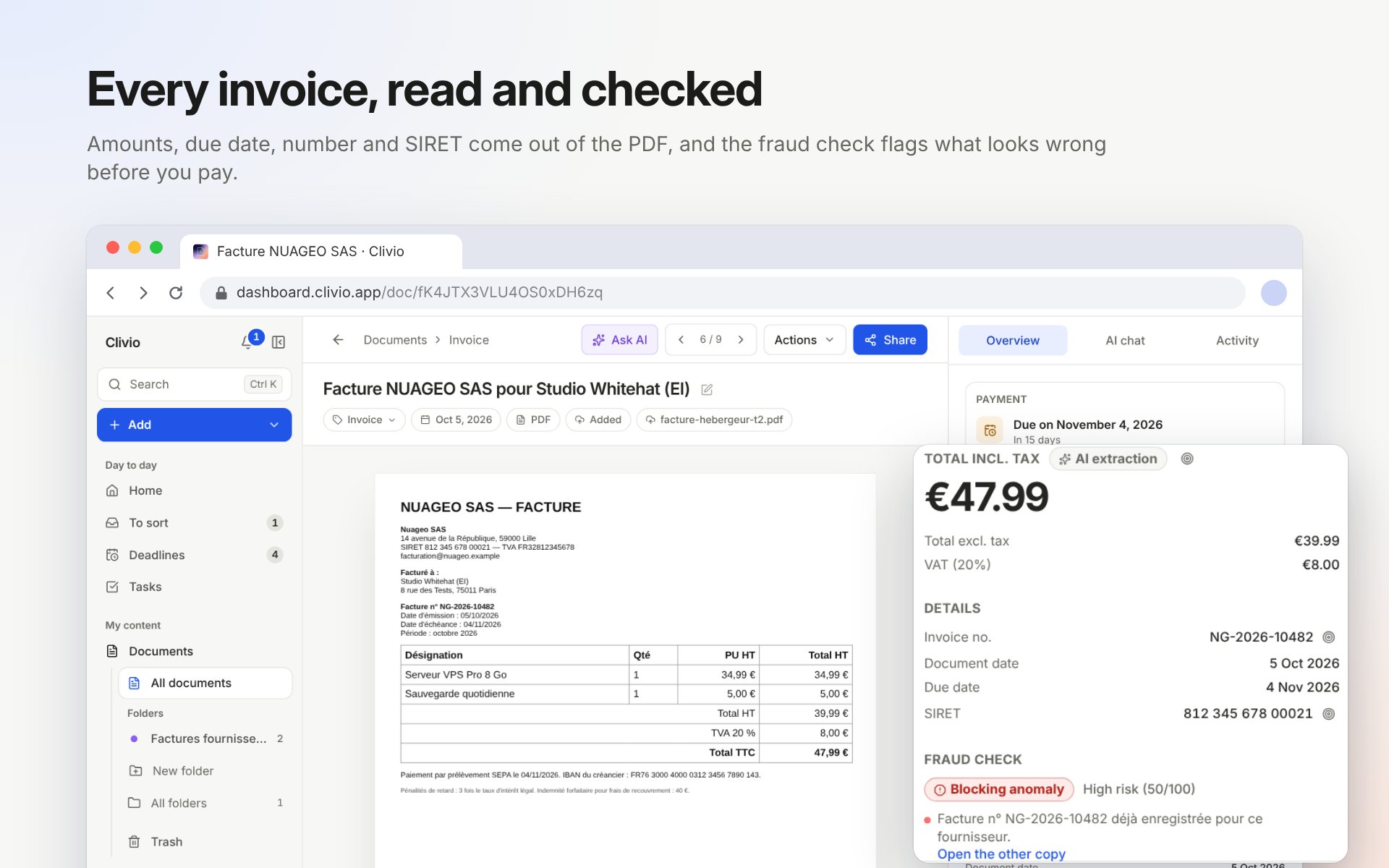
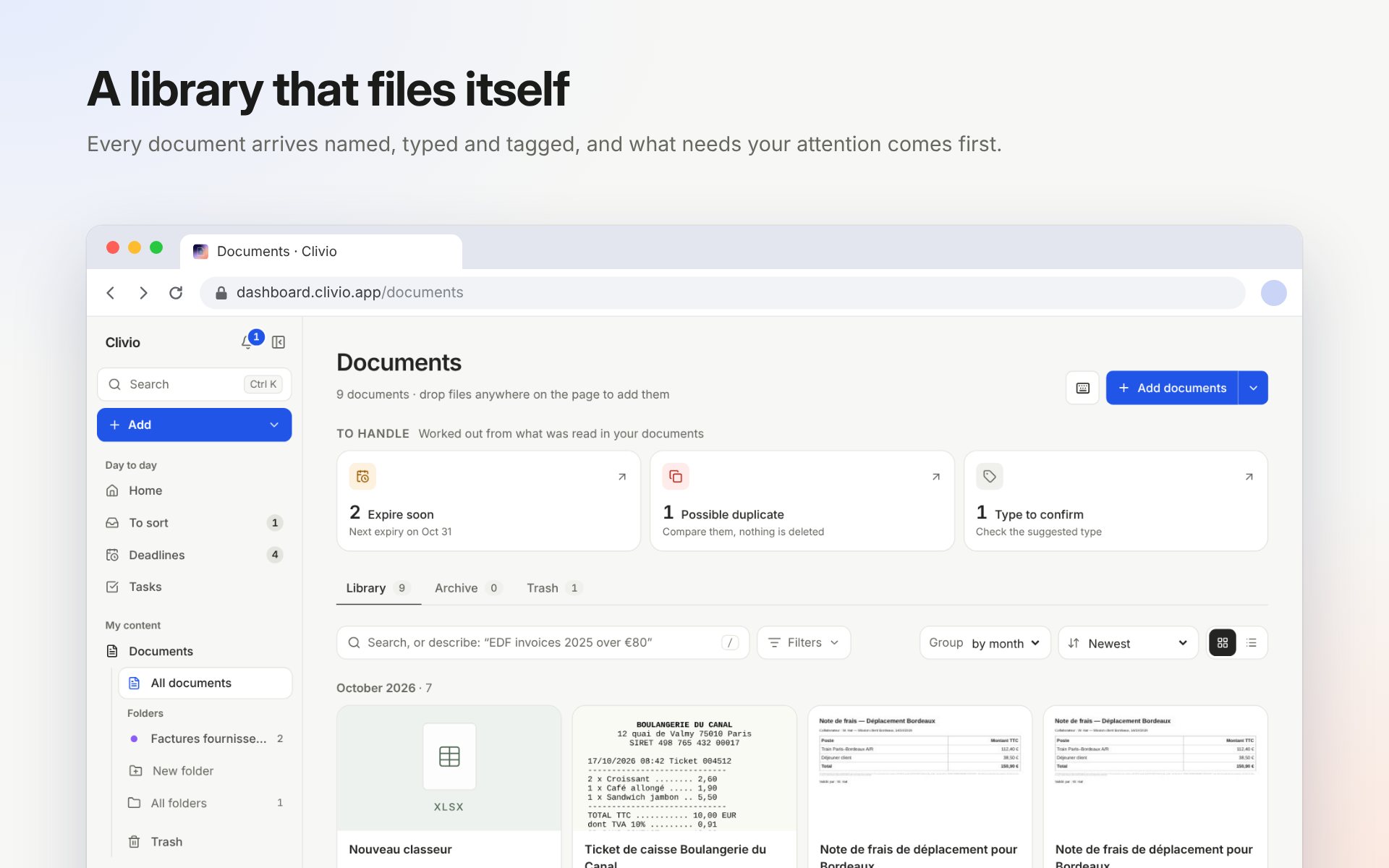
Invoices sit in an inbox, contracts in a Downloads folder, receipts in a camera roll. Drive or Dropbox will hold on to them forever, but finding the right one, or spotting the deadline written inside it, is still up to you. Clivio sits on top and does the reading. Every document that comes in gets named, tagged and filed, and you can then search it, add it up or ask about it.
Watch it read
A sample invoice from the Clivio films. Press the button and see what Clivio gets out of it. The details of how are on the next page.
Payment due 21 October 2026. Late payment fee: €40.
- Type
- Not read yet
- Supplier
- Not read yet
- Number
- Not read yet
- Total
- Not read yet
- VAT
- Not read yet
- Due
- Not read yet
- Filed in
- Not read yet
What’s inside
Seven parts of the app, each with its own short film.
Everything lands in one place.
Upload a file, forward an email to your own @inbox.clivio.app address, send it on WhatsApp, share it from your phone, or let a client drop it on a public page. New documents wait in To sort, already read, until you accept them.
- Ways in: upload and scanner, email, WhatsApp, Dropbox and Google Drive, drop page, client portal, the Android share sheet, the browser extension, API and MCP.
- Attachments are checked, deduplicated and rate-limited before anything else.
Your documents answer back.
Ask a question in French or English. The assistant answers only from your documents, and every claim carries a numbered citation that opens the PDF at the exact passage. The answer streams in, and you can stop it, copy it or ask again.
- Eight passages for each answer, from semantic and literal search together, no more than three from one document.
- Totals, counts and deadlines are computed from your data before the model is called, and cost no AI action.
Find anything, just by asking.
Press ⌘K from anywhere. Search matches the words you type and the meaning behind them, then merges both lists, so “when does the lease end?” finds the lease even if the word “end” isn’t in it.
- Literal and semantic results fused with Reciprocal Rank Fusion.
- Navigate, act or ask the AI from the same palette.
Your receipts do the math.
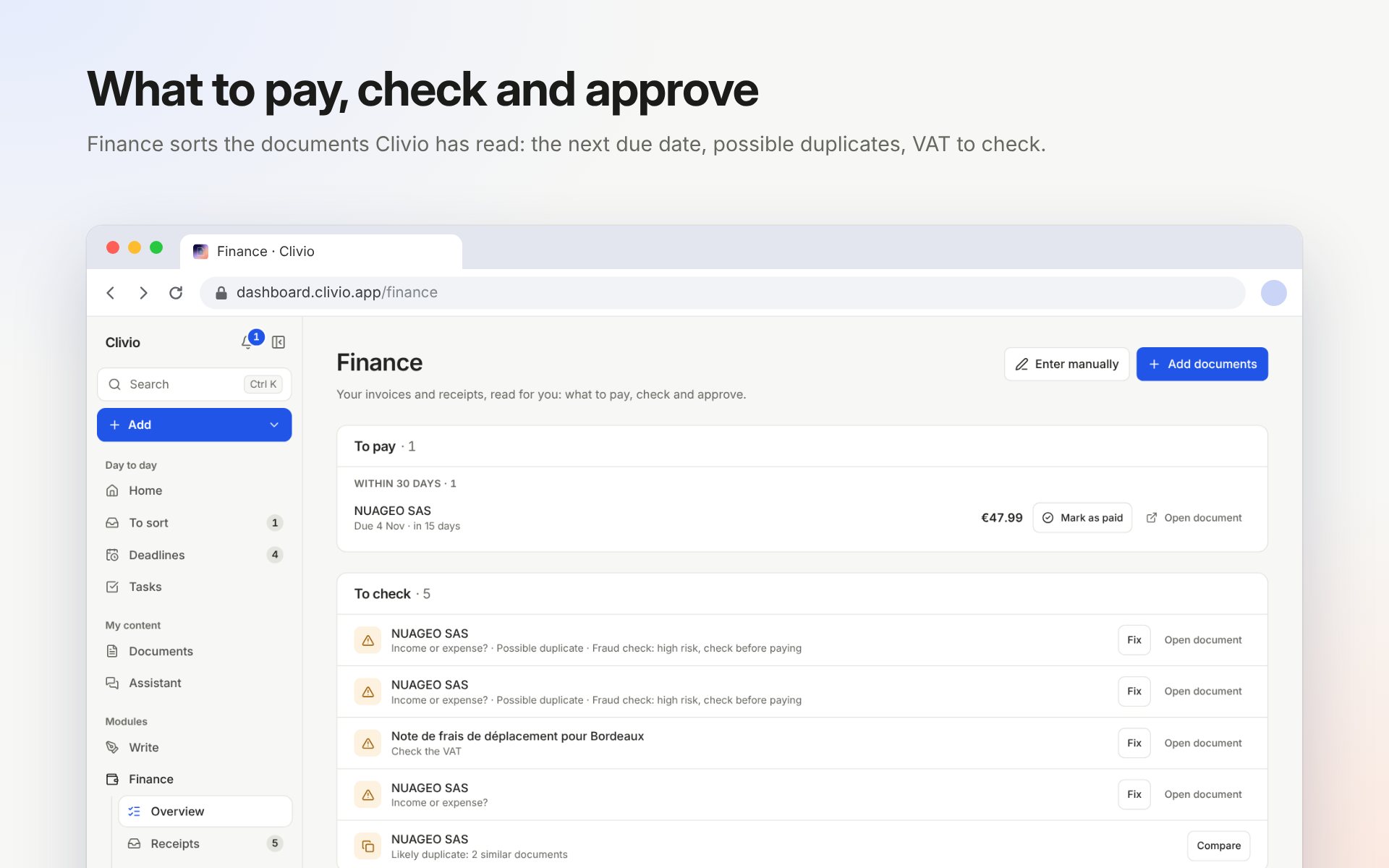
Finance opens on what to do: what to pay, what to check, what to validate. Each invoice or receipt becomes exactly one transaction, with its amounts, VAT, vendor and due date; credit notes come off the totals, and VAT follows your tax regime. With Pro, you can issue Factur-X invoices too.
- Factur-X e-invoices are read from their embedded data, not just their pixels, and issued with legal numbering.
- Payment reminders for invoices only, counted from the due date, with a capped tone and daily limits.
- Exports to CSV, Excel, PDF and FEC, the French standard accounting file, and connectors to Qonto, Pennylane and MyUnisoft.
Empty your head. AI structures the rest.
Type everything at once. Clivio turns the brain dump into a project, dated tasks and notes. It also finds the obligations hidden in your documents: a tax deadline, a renewal, a notice period.
Write from your own documents.
A full editor, on a par with Word for what matters: styles, headers, footnotes, mail merge, tracked changes, .docx in and out. Its assistant drafts from what’s in your vault: ask for a payment reminder and it takes the invoice number, the amount and the late fee from the right documents, then lists the sources it used.
Every document has a date.
Due dates, renewals and expiry dates come out of your documents and land on a calendar, with reminders before they bite. Recurring documents, like a monthly payslip, are tracked so you notice when one is missing.
Also in the box: smart folders, a knowledge graph, a directory of everyone your documents mention, a PDF editor, e-signature, a public API and an MCP server.
New in October
The week of 13 to 19 October alone brought 256 commits and 59 merged pull requests to the app. The main things it gained:
Invoices you can issue
With Pro, Finance now issues Factur-X invoices: legal numbering with no gaps, a PDF/A-3 made on the server with its XML, frozen once issued and corrected by a credit note. The code started as a free tool on the website.
19 Oct
Finance, rebuilt after an audit
Finance opens on what to pay, check and validate. One document makes one transaction, credit notes come off the totals, VAT follows your tax regime, reminders only go out for invoices, and every figure comes from the same calculation.
17 Oct
Accounting connectors
Qonto and Pennylane send their received invoices to Clivio every two hours, and get back the pieces you validated; MyUnisoft receives them. They switch on one provider at a time.
19 Oct
A spreadsheet
Excel, LibreOffice and CSV files open in Clivio: 135 functions under their French names, .xlsx read and written by home-made code, and what the editor doesn’t handle, like charts, put back on save.
18 Oct
Write, on a par with Word
Styles, headers and footers, a table of contents, footnotes, mail merge and tracked changes, with .docx in and out. And your own Word templates: fill in their {{tags}} and get a Word file, or a PDF ready to sign.
18–19 Oct
An assistant that counts
Totals, counts and deadlines are worked out from your data before the model is even called, so they’re right and cost nothing. Everything else draws on semantic and literal search together, and the answer streams in.
19 Oct
Automations that ask first
An action that sends or deletes something waits for your approval. New triggers come from Finance and signatures, a condition can be judged by the AI, and a rule that fails five times in a row pauses and tells you.
18–19 Oct
A client portal, piece by piece
Each request lists the pieces to provide, to check, validated or to send back, with one of six reasons in the client’s language. Reminders go out on day 3, day 7, then weekly, in the firm’s name.
19 Oct
Signatures and fields
Up to five signers, in order or all at once, each with their own link. Field templates you define are filled in by the AI, with the passage each value came from.
19 Oct
New ways in
Sign in with a passkey. Share a file to Clivio from an Android phone. PowerPoint, .doc, .odt and .rtf files now get a PDF preview.
19 Oct
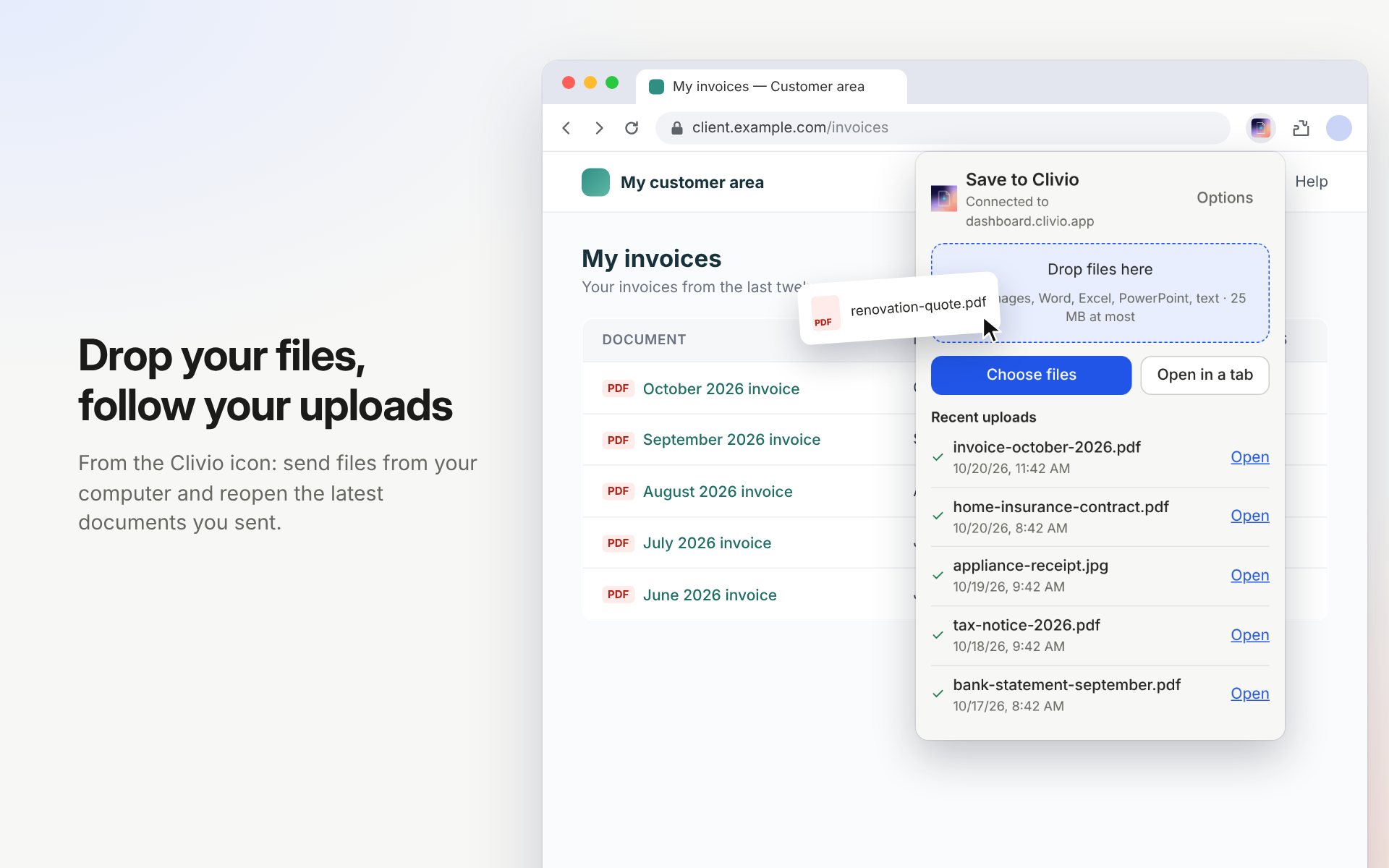
A browser extension
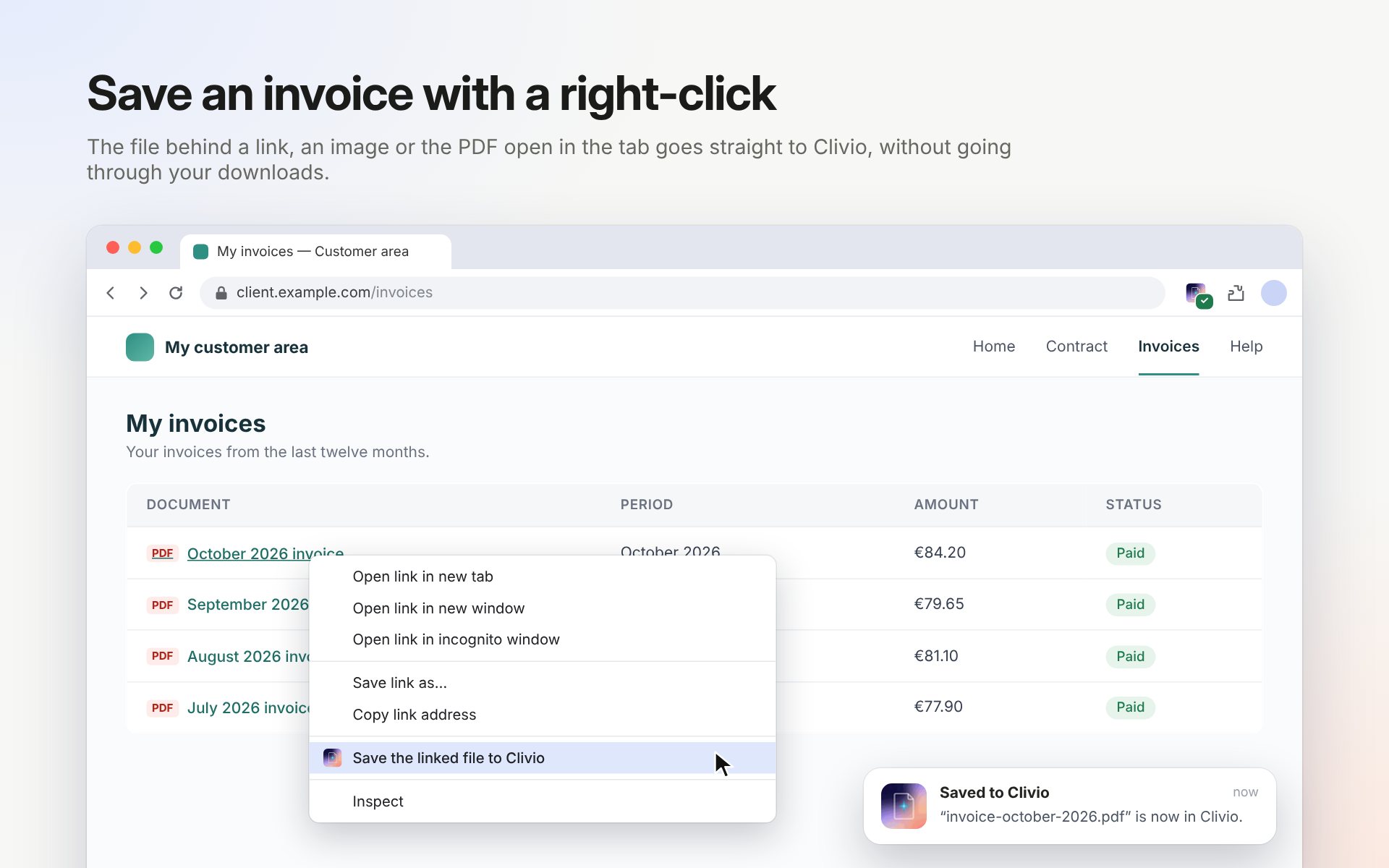
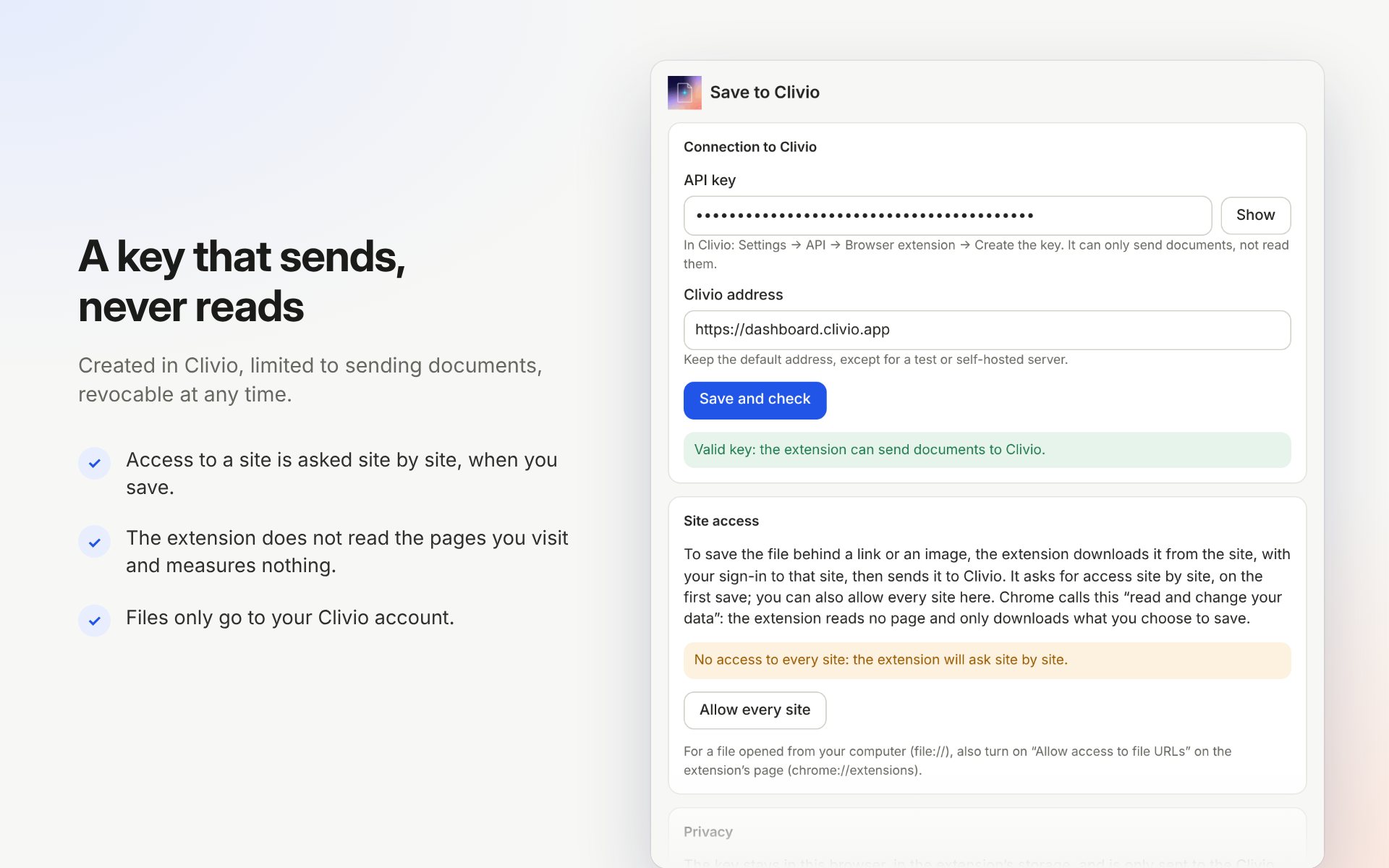
Right-click a link, an image or a PDF open in a tab, and the file goes to Clivio without a stop in Downloads. It signs in with an API key that can send but never read, asks for access one site at a time and reads no page. Coming soon to the Chrome Web Store.
19 Oct
From the browser
The screenshots I made for the extension’s Chrome Web Store listing. The window and the options page are the real ones, rendered from the extension’s code; the supplier page and the right-click menu are staged.
Twenty seconds each
Ten more things Clivio does, one short film each. Hover over a film, or tap it, to play it.
What’s next
It’s live, and it’s free to try.
Clivio is online at clivio.fr: 50 documents free, no credit card, and Pro at €14.90 a month with a seven-day trial. It’s solid enough to use every day, so I’m now spending more time with the people it’s meant for: freelancers and small businesses buried in invoices, right as French e-invoicing changes how they deal with them.
I’m going about it the way I would for a client. Talk to users, watch what they actually do, and keep the product focused on one clear promise.